Your New Competition
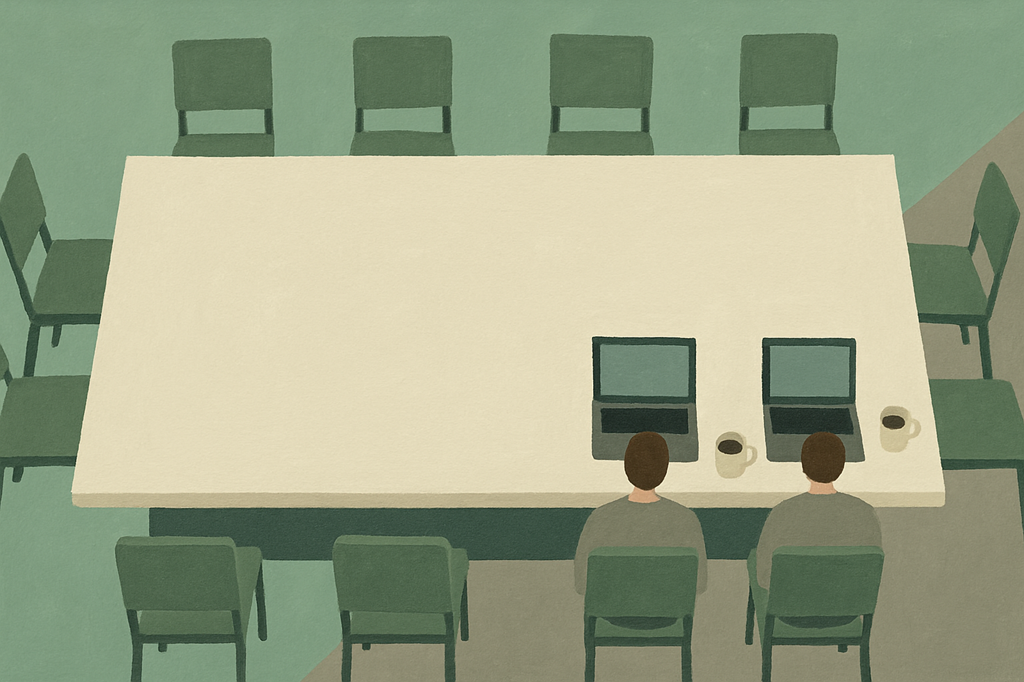
Meetings. Events where minutes are taken and hours wasted, as Captain Kirk famously didn’t say. Thirty years ago I had two meetings a week. A one hour status with my manager. Plus a one hour team meeting. It felt a lot; my life had been meeting free up to that point.
For the past couple of weeks I’ve been part of a modern development team. And shocked to reflect how much time is spent on meetings. This week there were 6.5 hours of team related meetings plus another 4 of other meetings. That 5% has turned into 25%. For the folk who work four days a week it’s even worse - they spend a third of their lives in meetings.
Part of this is a downside of agile; if you ask everyone their opinion you shouldn’t be surprised when you get a lot of opinions. It’s the brave engineer who says “nope, I’ve nothing to add, I’ll sit this one out.”
Then there’s meeting discipline; prepping for meetings, staying on track and managing time are skills that need to be learnt - but rarely taught. The result is too many attendees in too many meetings that run long.
These problems are endemic in the software industry. And very difficult to fix. In the short term they can be plastered over by adding more head count; growth is good right? Even if those extra folk make little impact or, worse, slow things down (Mythical Man Month anyone?) Up to now successful companies could get away with this - sure they were less efficient, but it wasn’t fatal. But AI changes that. In the past couple of months I’ve generated >300kloc of code. 1,200 Github commits. 50 repos. Sure, there has been a lot of experimentation, and none of the code is in production - yet. But AI makes it trivial to build prototypes to test the market. You can iterate fast, find out what works. And then when you decide what to build AI is there to help (assuming you have the skills to provide guidance and direction). I’ve also built lots of custom tools, some of which I use daily. They rarely work first time, but after a bit of tweaking I invariably end up with something which works and is well tested. Earlier this week Codex described the coverage of one of them as “quite good”. The coverage figure was 98.8%. How many human written tools have any tests, never mind having coverage in the high 90s? And AI continues to improve. This week we’ve had Gemini 3.0 and GPT5.1-codex-max. Both of which appear significant steps forward.
Your competition
It’s becoming clear that the biggest issue facing organisations as they adopt AI is, well, the organisation. The structures we’ve designed for humans don’t work in this new world. Meetings proliferate because coordination costs grow with team size. But if AI lets two people do what twenty did, the coordination problem disappears. For software companies the competition is about to change. It’s not who you thought it was; it’s a slew of new, small, nimble companies building better versions of your products and undercutting you. When it take one person six months to build what previously required a team of 20 for 5 years, things will change. Costs drop. Competition heats up. And you won’t just have one competitor; you’ll have hundreds since the barrier to entry is trivial. Yikes - what to do?
Changing embedded organisation structures is hard. Maybe impossible. It requires leaders to relinquish control, to give up fiefdoms. For managers who measure their success based on the size of their team this is going to be hard. Managing 2,000 instances of Codex doesn’t have quite the same cachet as 2,000 humans.
But having the wrong org structure invariably leads to failure. IBM found this out the hard way in the late 1970s. Back then, IBM had a profitable business hiring out mainframe computers. But with the arrival of the first personal computers, IBM realised personal computing - the switch from mainframes to a computer on every desk - was going to disrupt their business. So they decided to build a personal computer.
Problem was, the IBM org was designed around building high margin mainframes, not low margin PCs. The first few attempts failed - the IBM org just couldn’t move fast enough or build what was needed. Frustrated by the failures, the IBM chairman, Frank Cary, put together a skunks work team of ~ten people. They designed, built and shipped the IBM PC in under 12 months. It was an incredible success. The PCs we use today owe their existence to the work done by that team.
This approach provides a useful template for AI adoption. Rather than try to force organisational change, you need to start grow a new org from within. Skunk works teams - small teams of 2-3 people - focused on building fast. Free of the bureaucracy of the legacy org. These teams build new features rapidly. They build new products rapidly. They get early versions to customers quickly and find out if there is a market. If not, they move on; if there is, they iterate and build a finished product. It’s the ultimate promise of agile - truly rapid innovation and development.
Smaller teams make comms more efficient; they don’t need hours of planning meetings, hours of sync calls. They can make decisions quickly; no longer do we need hours of discussion between different teams to agree minor interface enhancements.
But what happens to the other 95% of the org? Do they just watch as these new small teams subsume their products? The reality is most organizations won’t adapt. They’ll rationalise, they’ll try to bolt AI onto existing structures, they’ll have task forces and working groups. They’ll seal their fate. They’ll do things they way they always have because they don’t know any different. They’ll keep having 10 hours of meetings even as it becomes clear those meetings are increasingly becoming organisational theatre.
This isn’t a theoretical risk; the tools we have today are good enough to drive this change. And those tools are only to get better. We’re rapidly approaching a point where leadership realises they don’t need all the engineers they currently have. And what then? Do they hope they can find useful roles for these engineers? Or start to clear the decks, inevitably putting themselves at risk too?
Existing orgs face existential risks; but equally there are amazing opportunities for the new disrupters - the new small companies who will build the products of the future. There is talk of billion dollar 2-3 person companies emerging within the next three years. As ever there will be winners and losers. But, if nothing else, smaller teams will mean fewer meetings. Perhaps, in years to come, we’ll look back on folk spending 25% of their week in meetings as some weird historical anomaly…
Originally published on Martin Davidson’s Substack. Follow Martin for more on AI and software engineering.